

Detecting thin bones, poorly calcified fragments and small bone splinters remains one of the major challenges of X-ray inspection in the poultry industry. With DeepScan, Multiscan Technologies brings Deep Learning-based artificial intelligence to its MXV-SLIM 6010 system, improving detection capabilities and reducing false positives. This innovation is already available and can be added to compatible systems through a software update, without replacing the machine.
The Challenge of Detecting the Most Difficult Bones in Poultry Processing
Minimizing the risk of bone fragments in the final product is one of the main food safety and quality control requirements in the poultry industry.
Although deboning processes have evolved considerably, certain fragments may remain in the meat and be particularly difficult to identify. These include thin, elongated bones, poorly calcified fragments and small bone splinters generated during processing.
The difficulty is not simply a matter of size. Bone density, orientation and the characteristics of the surrounding tissue can make a fragment difficult to distinguish in an X-ray image.
This challenge is particularly relevant to products such as chicken breasts and thighs, where differences in composition and thickness can complicate inspection.
For processors, an undetected bone fragment can lead to complaints, returns, reprocessing costs and a loss of customer confidence.
However, another equally important operational challenge is detecting more bones without unnecessarily increasing the rejection of acceptable product.
Increasing the sensitivity of conventional systems may improve the detection of certain defects, but it can also generate false positives. As a result, product that actually meets quality requirements may be removed from the line.
The goal is to strike the right balance between food safety, accuracy and production efficiency.
What Does Deep Learning Bring to X-ray Inspection?
Traditional X-ray inspection systems analyze differences in radiation attenuation and other image characteristics to identify potential defects.
This technology has proven effective in numerous industrial applications, but it has limitations when the differences between bone and surrounding tissue are small.
Deep Learning represents a significant step forward in how these images are interpreted.
Unlike conventional algorithms, which are primarily based on image characteristics and predefined detection rules, DeepScan uses trained neural networks to recognize complex patterns and interpret product characteristics in context.
For example, when several pieces of meat overlap, the accumulation of tissue can create higher-density areas that conventional algorithms may mistakenly identify as defects. Through the learning acquired during training, DeepScan can recognize these patterns and distinguish them from potential bone fragments, reducing false positives.
In poultry inspection, this improves the identification of bone fragments that may be difficult to detect using traditional methods.
The innovation is not about increasing X-ray power, but about improving the system’s ability to interpret the information it already captures.
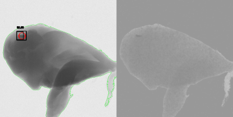
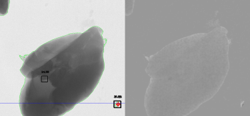
Bone fragment detection comparison: on the left, detection by both methods; on the right, detection exclusively by DeepScan.
DeepScan: A New Generation of Intelligent Inspection with the MXV-SLIM 6010
Multiscan has integrated its DeepScan technology, based on artificial intelligence and Deep Learning, into the MXV-SLIM 6010 X-ray inspection system for poultry applications.
The development is based on research, training and validation using images from different products and machines, with the aim of overcoming some of the limitations of conventional detection methods.
DeepScan is already available and can be added to compatible MXV-SLIM 6010 systems through a software update, without replacing the machine or installing additional graphics processing hardware.
This allows processors to enhance their inspection capabilities while making use of their existing infrastructure, simplifying the adoption of new technologies on their production lines.
Enhanced Detection of Thin and Poorly Calcified Bones
One of DeepScan’s main advances is its ability to identify bone fragments that have traditionally posed a challenge for X-ray inspection.
These include:
- Thin, elongated bones (needle bones): particularly relevant in certain poultry cuts, such as chicken thighs.
- Poorly calcified bones: their lower density can make them difficult to distinguish from surrounding tissue.
- Small bone splinters and bone scrapings: irregular fragments whose characteristics can be difficult for conventional algorithms to recognize.
Through advanced image analysis, DeepScan improves the ability to identify certain bone fragments that conventional methods may miss, extending the system’s inspection capabilities.
For quality managers, this provides a more advanced tool to address some of the most difficult risks to control in poultry processing.
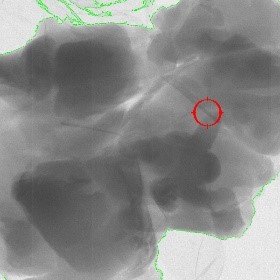

Example of thin, elongated bone (needle bone) detection: DeepScan (right) identifies a fragment missed by the conventional method (left).

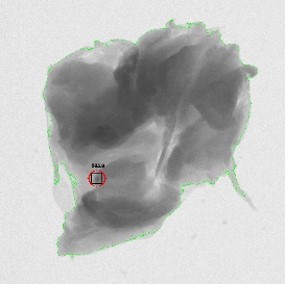
Example of low-density bone detection: DeepScan (right) identifies a fragment missed by the conventional method (left).
Fewer False Positives to Protect Production Yield
Effective inspection should be assessed not only by the defects it detects, but also by its ability to avoid unnecessary rejections.
When a system incorrectly identifies acceptable product as defective, it can generate additional handling, reinspection or reprocessing costs and affect line efficiency.
DeepScan improves the distinction between bone fragments and normal product characteristics, even in complex situations such as overlapping pieces, where accumulated tissue can lead to false detections. Its ability to recognize these patterns helps reduce false positives and avoid unnecessary rejection of acceptable product.
This enables more accurate quality control, where greater detection capability does not necessarily result in more usable product being lost.


Reduction in false rejects: conventional methods (left) generate multiple false detections, while DeepScan (right) improves accuracy and prevents unnecessary product rejection.
One Deep Learning Model for Different Poultry Products
Poultry processing plants routinely handle different cuts, formats and product characteristics. These differences may require specific adjustments to traditional inspection systems, increasing operational complexity.
One of DeepScan’s distinguishing features is that it uses the same Deep Learning model for different poultry applications, including the inspection of chicken breasts and thighs. This makes it possible to inspect both product types without using separate artificial intelligence models for each.
Although detection sensitivity can be adjusted according to the inspection requirements of each product, the artificial intelligence model remains the same.
This approach simplifies system configuration and facilitates its use in facilities processing different product types, reducing the complexity of adjustments for operators.
A Software Update That Expands System Capabilities
Adding artificial intelligence to industrial systems is often associated with new processing requirements and, in some cases, investments in additional hardware.
DeepScan offers an alternative for compatible MXV-SLIM 6010 systems.
Thanks to the optimization of its Deep Learning model, the technology can operate using existing processing resources, without requiring a dedicated GPU.
This makes it possible to upgrade the system through software and access new analysis capabilities without replacing the machine.
For processors already using this technology, it offers a simpler way to enhance their inspection systems, leveraging their existing investment and avoiding the purchase of a new machine to incorporate DeepScan.
Improving detection capabilities does not have to mean replacing the technology a company has already invested in.
DeepScan: Advancing X-ray Inspection for the Poultry Industry
Artificial intelligence is expanding the possibilities of industrial inspection, but its real value emerges when it helps solve specific problems that have traditionally been difficult to address.
With DeepScan, Multiscan advances X-ray bone detection by incorporating Deep Learning techniques to improve the identification of difficult fragments and reduce false positives associated with image analysis.
The combination of enhanced detection capabilities, a common model for different poultry products and the option of a software upgrade represents a significant advance for processors looking to strengthen quality control without compromising production efficiency.
Because the future of inspection is not simply about seeing more, but about better identifying what truly matters.
Discover DeepScan for Poultry Inspection
Looking to improve bone detection in your poultry processing line?
Discover how DeepScan can help you identify hard-to-detect bone fragments, reduce false positives, and optimize the performance of your inspection system.